
Jigsaw
Search Jigsaw

Trouble talking to your teen? Four small shifts that can make a big difference

Talking to teenagers can sometimes feel like trying to open a door that keeps closing.

Many parents want to support their young person, but they are not always sure how to start the conversation or keep it going.

In a recent webinar hosted by Jigsaw’s Neart Team, Dr. Kim Lombard spoke about practical ways parents can strengthen communication with their teens. Kim shared a simple framework built around four ideas that all begin with the letter “C”. These small shifts can help parents build stronger, more open relationships with their young people.

Start with self-compassion

Parenting a teenager can be challenging. It is normal to question your decisions or feel that you could have handled something differently.

Showing yourself compassion is an important starting point. This means treating yourself with the same kindness you would offer a friend in a similar situation. Instead of focusing on mistakes, try to recognise that parenting is a learning process.

When parents are kinder to themselves, it becomes easier to respond calmly and thoughtfully when challenges arise. This also creates space to reflect on situations and consider what might work differently next time.

Be curious, not judgemental

Curiosity can transform how conversations with teenagers unfold.

Sometimes, when a young person is struggling or acting out of character, our instinct can be to ask “What is wrong with you?” A more helpful question might be “What has gone wrong for you?”

This shift in language moves the focus from seeking to understanding. It shows your young person that you are interested in what they are experiencing rather than judging their behaviour.

Curiosity also applies to parents themselves. When a conversation does not go well, it can help to pause and reflect. Why did I react that way? What might I try differently next time?

This kind of reflection helps build stronger communication over time.

Focus on connection

Teenagers may seem more independent, but connection with trusted adults is still very important.

Being present and genuinely interested in what is happening in your young person’s world can help them feel safe opening up. This might be through small, everyday moments such as chatting in the car, walking the dog or sharing a meal.

The goal is not to have perfect conversations, but to create an environment where your young person feels heard and valued.

Move towards collaboration

When children are younger, parents naturally take on a strong leadership role to keep them safe and guide their decisions.

As young people move into their teenage years, they need more opportunities to practise making choices and navigating challenges. This means gradually shifting from directing to collaborating.

Working together to solve problems or think through decisions helps teenagers build confidence and independence. It also shows that you respect their views and trust them to play a role in shaping solutions.

Lead with compassion

Teenagers often face complex situations as they grow and develop. Responding with compassion can help them feel supported rather than criticised.

Compassion means acknowledging what your young person might be going through, listening to their perspective and helping them think about possible next steps.

Rather than rushing to fix the problem, the aim is to support them to find solutions that work for them and meet their needs.

Small changes can make a big difference

Talking to teenagers is not always easy, but small shifts in how we approach these conversations can have a powerful impact.

By practising self-compassion, staying curious, focusing on connection and working collaboratively, parents can help create a relationship where their young person feels understood, supported and able to open up.

And remember, there is no such thing as perfect parenting. What matters most is continuing to show up, listen and learn together.
These tips formed part of a webinar on Talking to Your Teen delivered as part of the Jigsaw’s Neart Programme for schools, in collaboration with the National Parents Council. To find out more about the programme and future webinars subscribe to the Neart newsletter through the button below. 

SEVEN ways to reset & improve well-being

Have you ever just needed a minute of calm? We all feel overwhelmed from time to time.

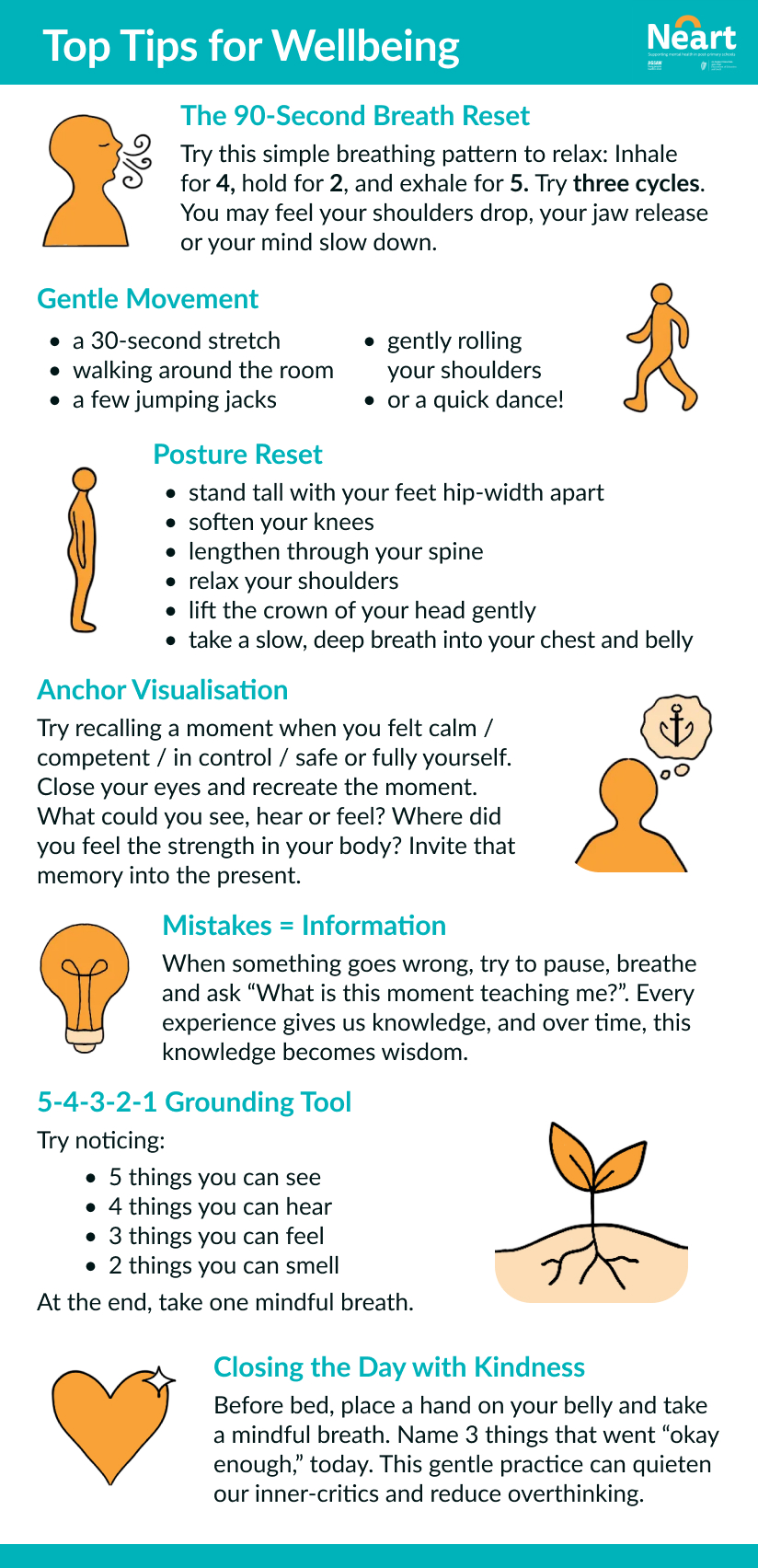
Jigsaw’s Neart Programme have put together a guide of Top Tips for Well-being to help you take a minute to reset and get grounded.

Shaped by the contributions from the Neart Parent & Guardian Network, this guide offers simple practices to bring steadier moments to everyday life. These small, practical tools are designed to support your wellbeing, especially when life feels like it’s moving at a more challenging pace.

If you are a parent who would like to know more about the Neart programme to support well-being in post-primary schools you can subscribe to their newsletter by clicking the button.

Supporting Student Wellbeing: Turning ESRI evidence into action in schools

Jigsaw welcomes this morning’s article in the Irish Times highlighting the recent report from ESRI on Supporting Student Wellbeing in School Contexts.

There is little doubt that the global deterioration in our young people’s mental health is the most significant and cross-cutting issue facing our society today.

And we all have a role.

Jigsaw’s Neart programme, developed and delivered in partnership with the National Educational Psychological Service (NEPS)/Department of Education and Youth, focuses on strengthening the whole school environment and support systems around students, fostering positive school culture, the centrality of supportive relationships and sense of belonging for all, which promote and support student wellbeing.

This approach strongly aligns with the evidence-based recommendations of the report. In recognition of the increased challenges of minoritised students referenced in this article, Neart also has an ongoing workstream on supporting the specific wellbeing needs of minoritised groups, holding equity, true inclusion and belonging for all front and centre.

Neart offers direct and practical support to schools to build the necessary skills and take evidence-informed actions to promote student wellbeing through of suite of supports for school staff and parents, including webinars, a podcast series, in-person regional conferences, online resources and our Neart Wellbeing Award.

Neart aims to support schools to create an environment that promotes the wellbeing of the entire school community. This whole school approach, involving school leaders and all staff, parents and young people, is essential in moving from individual ownership to collective responsibility.

As referenced in the recent ERSI report, the creation of this supportive environment is essential in supporting belonging and connectedness – key ingredients in supporting the student, but also those around them – educators, school leaders, staff and parents.

Key to the successful implementation of any wellbeing initiative in schools is student involvement from the start. As pointed in the ERSI  report, “There are few better opportunities to hand over responsibility than in the design and implementation of school wellbeing initiatives… Students are the experts on their own subjective wellbeing and should be central to decision-making around whole school wellbeing efforts.”

Please see www.jigsaw.ie/neart for further information on how we can support your school on your wellbeing journey.


Schools must be empowered as frontline of youth mental health crisis – Jigsaw

Jigsaw has called for continued action to embed greater mental health supports and training in schools, following today’s publication of the ESRI’s Supporting Student Wellbeing in School Contexts report.

Mike Mansfield, Director of Communications & Fundraising at Jigsaw, said: “We strongly welcome this report. It confirms what we see every day – schools are on the frontline of our youth mental health crisis, yet educators remain ill-equipped. With 75% of mental health difficulties that persist into adulthood starting before age 25, we cannot afford to wait. While we acknowledge the government’s recent significant investment in youth mental health and progress in educational policy, far more attention must be devoted to preventing mental ill-health in schools, rather than simply intervening as it arises.”

The ESRI findings echo Jigsaw’s experience working with more than 580 schools nationwide through our Neart programme, which supports schools to create a more positive mental health environment for students and staff. Research shows adolescents with better school connectedness have lower levels of self-harm, anxiety and depression – yet the top three stressors for young people all revolve around school: general issues, exams and homework, affecting Ireland’s 370,000 post-primary students.

“The solutions to the crisis in our youth mental health system lie as much outside the therapy room as in it,” Mansfield continued. “Kitchen tables, playing pitches and classrooms – these are the fertile grounds for improved mental health supports. The ESRI report rightly calls for embedding mental health supports in schools and strengthening teacher mental health literacy. Investment in keeping young people well, rather than waiting until they are very unwell, will save money – but more importantly, it has the potential to save young lives.”

Jigsaw stands ready to work with government, educators and communities to ensure every young person gets support when they need it most.

Neart is the national programme of wellbeing supports for post primary schools, and is a partnership between Jigsaw and NEPS (National Educational Psychological Services) / The Department of Education and Youth. Neart has a focus on strengthening the whole school environment and support systems around student, fostering school culture, relationships and belonging which support student wellbeing, which aligns well with the recommendations of the report. Neart also has an ongoing workstream on supporting the specific wellbeing needs of minoritised groups, holding EDI front and centre.

ENDS

How to manage exam stress

Exam stress impacts everyone. Learning how to manage it is essential to success and well-being at school.

As part of Jigsaw’s new schools programme Neart, the team has produced a podcast which provides tips and advice on how to understand and manage the stress of exams for students and parents.


Listen here


In this episode, the Neart schools team talks to Dr. Kim Lombard from Jigsaw, Catríona Rodgers and Eoin Houlihan from the Institute of Guidance Counsellors, Áine Lynch from the National Parents Council, Joe Leonard, principal of Cross and Passion College in Kildare, and Cian and Katie from the National Comhairle na nÓg.

We discuss the impact exam stress has on young people and families, how parents can recognise when a young person is experiencing a worrying level of stress, some practical ways parents can support young people, and possible avenues of further support for both young people and their parents.

The Neart Youth Mental Health Podcast is brought to you by Jigsaw, The National Centre for Youth Mental Health, and the Department of Education and the National Educational Psychological Service.

Information on the organisations and supports mentioned can be found here: Exam Stress Episode resource

A general list of supports for parents & guardians can be found here: Parent & Guardian Support List

To sign up for the Neart Parent newsletter and access further supports, register here: Neart Parent Registration

For more information on Neart visit www.jigsaw.ie/neart


Minister McEntee launches Neart

PRESS RELEASE

Minister for Education, Helen McEntee TD, has launched Neart, the new national programme of mental health and wellbeing resources and training for post-primary schools. Neart is being delivered in a partnership between the National Educational Psychological Service (NEPS) and Jigsaw – The National Centre for Youth Mental Health.

Neart – the Irish word for strength, provides learning opportunities that promote student mental health and wellbeing as well as mental health webinars and e-Learning courses for parents and school staff.

Minister McEntee welcomed the launch, saying:

“I am delighted to launch Neart – the new national programme of mental health and wellbeing resources and training for teachers, students and parents, in partnership with Jigsaw.  

“It has never been so important that children and student’s mental health is supported in our schools. Particularly with the impact of social media, it is vital that we support school communities around mental health to ensure that students are equipped to speak about their mental health and wellbeing. 

“While wellbeing supports have been in schools for some time, the needs of students and teachers are ever-evolving and so it is timely that we are add to these supports for our post-primary schools. 

“I want to thank everyone who worked on this initiative and crucially, I would encourage every post-primary school to register with the service and avail of the supports on offer, to help their students and teachers alike.” 

Welcoming the initiative, Dr Joseph Duffy, CEO of Jigsaw, said:

“Jigsaw is delighted and proud to have been selected to provide Neart, in collaboration with NEPS and the Department of Education. Through this programme, we are fully committed to providing everyone within the school community with the knowledge and confidence to speak about mental health and wellbeing, to challenge stigma and, collectively, to work together to create a positive, enriching, and protective environment for all.”  

The Department of Education believe that Jigsaw’s existing experience delivering initiatives supporting the mental health of young people across post-primary schools made them an exemplary partner in this initiative. Their work will complement the supports already available in schools that include: the provision of guidance counselling, the work of the National Educational Psychological Service (NEPS), as well as the existing wellbeing programmes and initiatives including the Student Support Team structure.

Schools can sign up to the new service by logging on to https://jigsaw.ie/neart where they will find information and support for school leaders, school staff, for student support teams and for parents and guardians and to check out upcoming training and webinars on offer throughout 2025.

 Notes for editors: 

NEART | Classroom resources | Jigsaw.ie

Supports and programmes Jigsaw will provide:

Supports for students that will:

  • Enhance the capacity of Student Support Teams to actively seek and respond to the voice of young people in relation to wellbeing and mental health in schools
  • Provide learning opportunities for students that promote mental health and wellbeing

Support for parents will:

  • Enhance parent/carer involvement in wellbeing school initiatives and engagement in promoting wellbeing and mental health in the school community
  • Enhance Student Support Teams to actively seek and respond to the voice of parent/ guardian in relation to wellbeing and mental health in schools
  • Provide psychoeducation on the promotion of wellbeing/mental health for parents via webinars and e-Learning opportunities.

Supports for school staff will:

  • Build capacity of staff to promote whole school approaches to wellbeing and mental health awareness
  • Enhance training and support for Student Support Teams to raise awareness of positive mental health and wellbeing
  • Provide e-learning opportunities for staff on mental health and wellbeing promotion
  • Provide wellbeing and self-care webinars and eLearning courses for school staff

Parent | Post-Primary Mental Health Support Survey

Jigsaw has just announced the delivery of the new NEART programme. We are asking parents and guardians of young people aged between 12 – 18 years old, to take part in a survey.

At Jigsaw we provide a range of supports for parents/guardians more widely through our local Jigsaw services, in the community and through our website. We want to provide the most relevant information, advice and support and practical strategies for you as a parent/guardian, to enable you to support your young person’s mental health.

To help us do this we would like to hear from you about the youth mental health issues you are most concerned with in a very short survey which you can find at the bottom of this page or by visiting: https://jigsawymh.typeform.com/to/GyFrkdtd

The survey takes no longer than 4 minutes to complete.

Within the survey, there is also an opportunity for you to sign up to participate in a follow-up consultation process with us where we are very keen to have further discussions with parents/guardians about the mental health areas you are most concerned about.

We look forward to hearing your thoughts so that parents/guardians like you across the country are receiving the best information and supports.

Back To Top